By Teresa Coats & Justin Coats
When we founded LearnAIR, we wrote a mission statement that felt ambitious, perhaps even a little idealistic: "Usher Humanity into the AI Era." It wasn’t just about software or efficiency; it was about people. It was about ensuring that as the tectonic plates of technology shifted, humans weren’t just left standing in the rubble, they were building the new skyline.
Last month, that mission took us halfway across the world.
We packed our bags, our frameworks, and our deep belief in human potential and traveled to India. The goal was simple on paper but profound in practice: to teach diverse groups from high-powered executives at PepsiCo India to eager students and operational teams, how to truly leverage tools like ChatGPT, Gemini, and CoPilot.
What we found in Bengaluru, Delhi, and Mumbai wasn't just a market ready for AI; we found a mirror reflecting the future of work. We saw a hunger not just for "tech skills" but for a new way of thinking. The energy was electric, the questions were piercing, and the reception was humbling.
We went to teach, but we returned having learned just as much. The trip crystallized our vision and validated our approach in ways we hadn’t anticipated. As we engaged with hundreds of minds, five massive learnings emerged, truths that don't just apply to the Indian market, but are fundamental to how every organization, everywhere, must approach AI.
Here are the five biggest learnings from our trip to India, and how they are reshaping the future of LearnAIR.
1. AI Literacy Is a Global Urgency, Not a Luxury
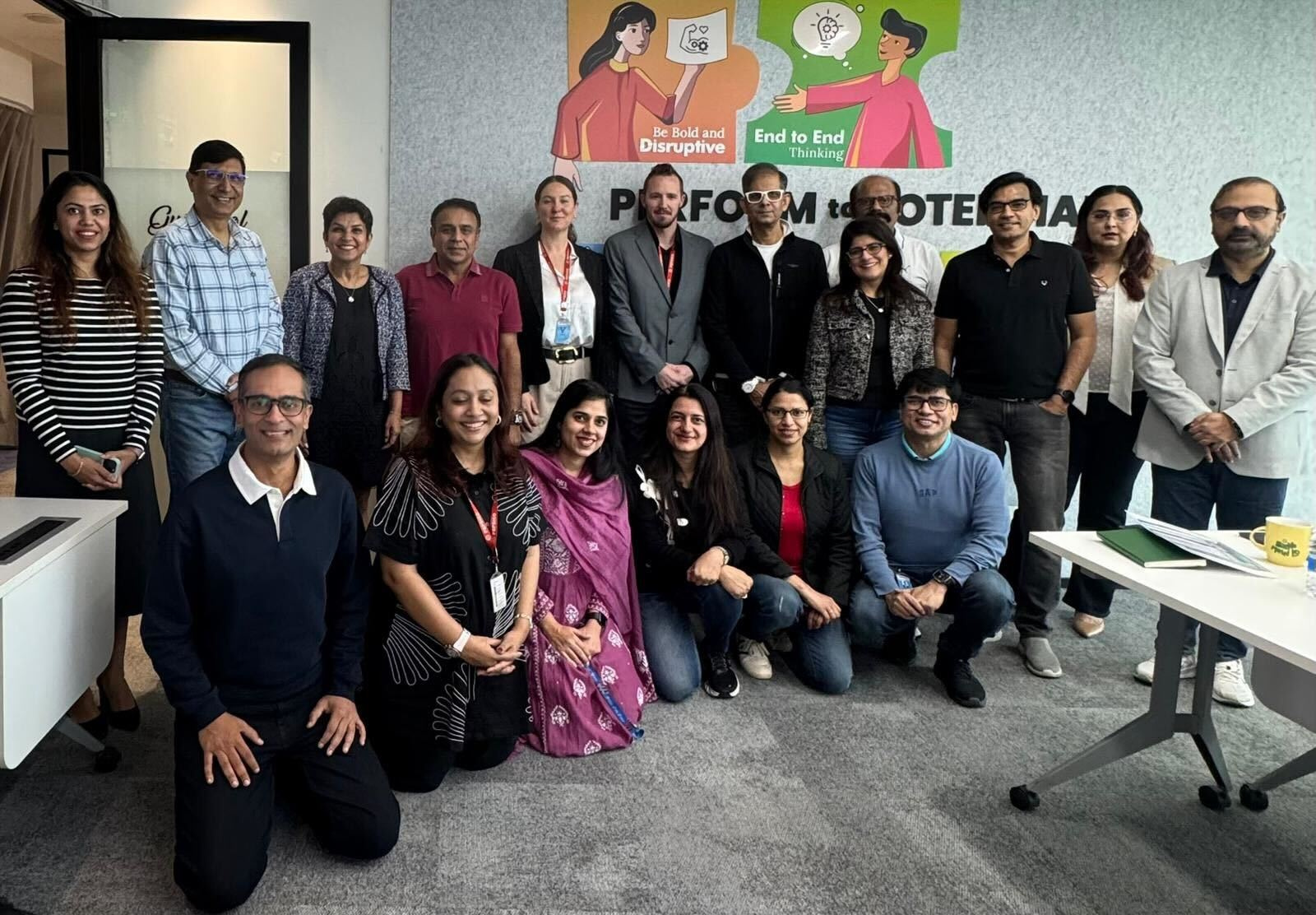
In the West, we often hear AI discussed as a competitive advantage, a way to get slightly ahead or optimize a workflow. In India, the conversation is different. It is visceral. It is urgent.
In India, AI isn’t a “nice to have” or a shiny new toy for the IT department. It is viewed fundamentally as a pathway to economic mobility, efficiency, and massive scale. The professionals we met understood that AI is the great equalizer. If you can master these tools, you can compete with anyone, anywhere. The hunger to learn wasn't born out of curiosity alone; it was born out of necessity.
We saw this same urgency echoed in the eyes of the leadership team at PepsiCo India. They weren’t looking for parlor tricks. They were looking for structural transformation. They wanted to know how to take their workforce, vast, diverse, and talented and give them superpowers.
The LearnAIR Takeaway: We’re not early. We’re right on time.
The need for what we do is bigger than any one market or any one industry. The global workforce is waking up to the reality that AI literacy is the new literacy. It is as fundamental as reading or writing in the modern economy.
We see this validation in our own customer base back home, too. Heather Martin, the Executive Director at Central Oregon Veterans Ranch, told us, "ChatGPT is one of three programs I open every morning. It's a multiplier for me, helping with everything from grant writing and donor outreach to project planning." 1
That word multiplier is key. In India, we saw a nation of billion people looking for a multiplier. It reinforced a broader truth we’re seeing everywhere: AI literacy is no longer optional for modern workforces.. We are ushering in an era where AI fluency is the baseline for employability, and India showed us that the clock is already ticking.
2. Context Matters More Than Tools
It is easy to get obsessed with the models. Is Gemini better than ChatGPT? What about CoPilot? While we spent time teaching the specific nuances of each platform, the "aha" moments never came from a feature update. They came from context.
We found that the same AI tools landed very differently depending on the role, the culture, and the constraints of the user. A marketing executive at PepsiCo needed AI to understand brand voice and nuance. An operational manager needed it to strip away administrative drudgery. A student needed it to synthesize vast amounts of information.
When we taught "buttons" click here - type this, the engagement was polite. When we taught "context" - how to frame a problem, how to give the AI a role, how to iterate - the room lit up.
The LearnAIR Takeaway: Teaching how to think with AI matters more than teaching what buttons to click.
This is the core of our "Human-First" pedagogy. The tool is useless without the human context driving it. We have to teach people to be the architects of their own workflows, not just operators of a machine.
We’ve seen this play out powerfully with our clients. Marcee Hillman Moeggenberg from Cascade Business News shared a perfect example of context in action: "Learning to create a detailed editorial Persona, and then feeding it our style guide, has been incredible... It's like having a new best friend in the office." 2
Marcee didn’t just "use ChatGPT." She gave it context. She gave it a Persona. She fed it a style guide. She taught it to be a colleague rather than a calculator. That is what we saw in India, too. The moment a user understands that they can impart their context to the AI, the fear evaporates, and the utility skyrockets. Our curriculum must remain relentlessly focused on this skill: the art of contextualizing work for a digital teammate.
3. People Want Confidence, Not Complexity
There is a temptation in the tech world to dazzle with complexity. We want to show off the most advanced agents, the wildest automations, the most complex code-generation capabilities.
But standing in front of rooms full of people in India, we realized that complexity often breeds intimidation. The most powerful moments of the trip weren’t the advanced use cases. They were the moments of relief. They were the moments of clarity.
It was the moment a manager realized, "Wait, I don't have to spend four hours formatting this report anymore?" It was the collective exhale when a team realized AI could handle the 80% of the work they hated, freeing them to do the 20% they loved.
The LearnAIR Takeaway: Our job is to remove fear and friction, not add sophistication for sophistication’s sake.
If we make AI look like magic that only wizards can wield, we fail. If we make it look like a hammer that anyone can pick up, we win. Our goal is to build confidence. We want our students to leave a session feeling taller, not smaller.
We hear this consistently from our users who find relief in the simplicity of the solution. Nicole from TeamDynamics captured this sentiment perfectly when she said, "It literally came up with... almost verbatim what I would have done, but in about three seconds versus me taking, you know, a couple hours at least." 3
That isn't just efficiency; that is relief. That is the gift of time. Kevin Hope at KLG/Surgent echoed this when he talked about fixing formatting messes: "A faculty member turns in formatting messes that took me 1hr to fix. ChatGPT did it in 10 minutes. Incredible time saver!" 4
These aren't stories about complex coding agents. They are stories about solving annoying, human problems with speed and confidence. India taught us that the "killer app" for AI isn't a new feature; it's the confidence to say, "I can handle this."
4. Human-First Is Not a Slogan - It’s the Differentiator

In a country as populous and diverse as India, you might expect technology to be viewed as a way to replace humans. Instead, we found the exact opposite. Trust, respect, and dignity came before technology in every meaningful conversation we had.
The questions we fielded weren't just about "how do I automate this?" They were about "how do I use this to help my team?" "How do I ensure this is ethical?" "How do we maintain our culture?"
We realized that in a world flooded with synthetic intelligence, human intelligence becomes the premium asset. The ability to empathize, to judge, to curate, and to connect - those are the things AI cannot do. Our training resonated so deeply because we didn't start with the machine; we started with the human.
The LearnAIR Takeaway: “Don’t Forget the Human Part” isn’t branding - it’s the strategy.
This is our North Star. We are not an AI company; we are a human potential company. We use AI to unlock humans. This philosophy is our greatest differentiator in a crowded market of technical bootcamps.
Our clients feel this difference. It changes how they view their work. Steve Mclaughlin from KLG/Surgent noted, "The Persona creation was scarily good!" 5 But why was it good? Because it allowed him to offload the rote administration, like CE approval applications, so he could focus on the human expertise of course creation.
Scott Reasor from Impact EMS shared a similar epiphany: "I had an epiphany! I'm using ChatGPT for a whole org review, feeding it staff strengths, weaknesses, org structure to identify gaps, optimize roles..." 6
Scott wasn't replacing his people; he was using AI to understand them better. He was using technology to optimize for human strengths. That is the Human-First approach in action. India reminded us that technology without humanity is cold, dead, and ultimately ineffective. We must always keep the human heart beating at the center of our curriculum.
5. Scale Comes From Systems, Not Heroes
Finally, we learned a crucial lesson about scale. In the early days of AI adoption, you often see "AI Heroes," that one person in the office who is a wizard with ChatGPT. They do amazing things, but when they leave, the capability leaves with them.
In India, watching organizations the size of PepsiCo operate, it became obvious: Heroes don't scale. Systems do.
The biggest opportunities we identified weren't acts of individual brilliance. They were repeatable, teachable frameworks. They were prompts that could be shared across a department. They were "Digital Employees" that could be cloned and distributed. They were governance structures that allowed innovation to happen safely.
The LearnAIR Takeaway: If it can’t scale through people and process, it’s not the right solution.
We are moving past the era of the "AI wizard" and into the era of the "AI System." Our training must focus on building these systems; repeatable workflows, shared prompt libraries, and custom GPTs that the whole team can use.
We are already seeing the fruits of this systemic approach. Alex Larson at Martin Outdoor Properties told us, "Used AI to summarize property offers, saving time for the team." 7 Not just for himself - for the team.
Similarly, an Operations Team case study we conducted showed that by implementing these systems, they "Regained 10+ hours/week for strategic work." 8 That is systemic scale. That is what happens when you move from individual tinkering to organizational transformation.
India showed us that for AI to truly usher humanity into a new era, it cannot remain the domain of the elite few. It must be systematized, democratized, and scaled to the many.
Conclusion: The Road Ahead
Our trip to India was more than a series of workshops; it was a glimpse into the future. We stood in boardrooms and classrooms and saw the same look in everyone's eyes: a mix of trepidation and thrill.
We learned that the world is ready. They are ready not just for tools, but for a partner who can guide them with empathy, clarity, and a human-first touch.
We returned to the US with our conviction stronger than ever. The five learnings from India: Urgency, Context, Confidence, Humanity, and Systems - are now the pillars of our next chapter at LearnAIR.
What we saw in India is the same opportunity we see emerging in innovation hubs everywhere, including right here in Oregon, where talent, curiosity, and applied AI literacy can reshape entire industries.
We are ushering humanity into the AI era, one human, one team, and one "aha" moment at a time. And as we learned in India, we are right on time.
If this human-first approach to AI literacy resonates and you’re ready to build confident, scalable systems that truly support your team, reach out to Techworks to learn how we can help.

Ready to become a member?
Reach out today to discover all the ways Techworks can help your tech company thrive.